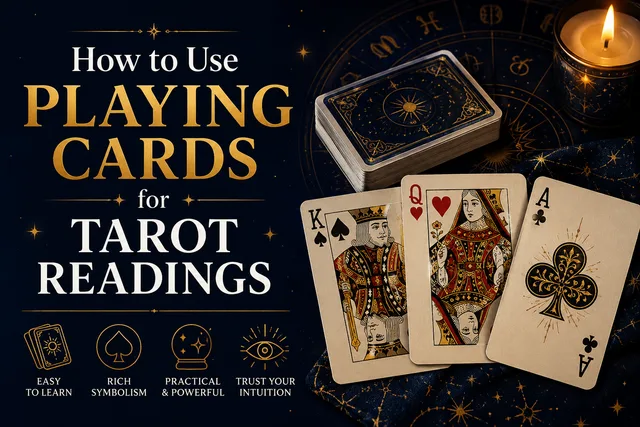
You don't need a tarot deck to read tarot. A standard 52-card playing deck maps almost one-to-one onto the tarot's Minor Arcana — four suits, numbered cards, and court cards — so you can give a real reading with the cards already in a drawer. Here's how the two decks line up, what you trade away, and how to run a simple reading.
The suit correspondences
The tarot's four Minor Arcana suits each have a playing-card equivalent, and each governs a theme:
| Playing-card suit | Tarot suit | Theme it reads for |
|---|---|---|
| ♥ Hearts | Cups | Emotions, love, relationships |
| ♦ Diamonds | Pentacles (Coins) | Money, work, the material world |
| ♣ Clubs | Wands | Drive, action, creativity, ambition |
| ♠ Spades | Swords | Thought, conflict, truth, difficulty |
Numbered cards keep their tarot meaning by number and suit — the Ace of Hearts reads like the Ace of Cups (new emotional beginnings), the Ten of Spades like the Ten of Swords (a painful ending), and so on.
The court cards
Playing decks have three court ranks; tarot has four. The common mapping:
- Jack → Page or Knight (the youthful / messenger energy)
- Queen → Queen
- King → King
If you want the missing Knight, some readers split the Jack's role by context, or simply read three court figures instead of four.
What you gain and what you lose
The trade is honest and worth knowing up front:
- You keep the entire 56-card Minor Arcana structure — the everyday, situational layer of a reading, which is most of it.
- You lose the 22 Major Arcana cards — the Fool, Death, the Tower, the Wheel of Fortune, and the rest. Those carry the big, archetypal turning points, so a playing-card reading runs closer to the ground: practical and situational rather than fated. (Some readers let the Joker stand in for the Fool to recover one card of that layer.)
How to do a simple reading
- Pick a spread. A three-card past / present / future line is the easiest start.
- Frame a question and shuffle while you hold it in mind.
- Draw your cards and lay them out left to right.
- Read each card by combining its suit theme (above) with its number or court rank.
- Read the cards together — the story is in how they relate, not in any single card alone.
That's enough to start. The fluency comes from doing readings, not from owning a fancier deck.
A worked example
Say you ask about a job decision and draw three cards: Eight of Diamonds, Five of Spades, Ace of Clubs. Reading by suit and number:
- Past — Eight of Diamonds (Pentacles): steady, diligent work; you've been heads-down building skill and security.
- Present — Five of Spades (Swords): tension and conflict; a clash of ideas, a setback, or a win that cost something.
- Future — Ace of Clubs (Wands): a fresh burst of drive and a new venture — the spark to start something of your own.
Read together, the line suggests groundwork giving way to friction, then to a new beginning that demands initiative. Notice the method: each card's meaning comes from its suit theme plus its number, and the reading comes from the relationship between the three.
A few tips
- Reversals are optional. Many cartomancy readers don't read upside-down cards at all — decide before you start and keep it consistent.
- Let face cards be people. Court cards (Jack/Queen/King) often represent someone in the situation; ask who the card reminds you of.
- Keep a notebook. Writing down the cards and what actually happened is how the suit meanings move from a chart to instinct.
- Start small and read often. A daily one-card draw teaches the suits faster than an occasional elaborate spread; the goal early on is reps, not complexity.
FAQs
Can you really use playing cards as tarot cards? Yes. A 52-card deck maps onto the tarot's Minor Arcana suit-for-suit, so you can read with it directly.
Which playing-card suit matches which tarot suit? Hearts→Cups, Diamonds→Pentacles, Clubs→Wands, Spades→Swords.
What about the Joker? Some readers use the Joker as a stand-in for the Fool, recovering one card of the Major Arcana.
Do I need the Major Arcana? No — but without it your readings lean practical and situational rather than archetypal, since the 22 Major cards (Death, the Tower, etc.) aren't in a standard deck.
Related articles
- Tarot card meanings list — meanings to pair with these suits.
- Playing card meanings
- Tarot card layouts — spreads to try beyond the three-card line.
- Latin tarot & the Rider-Waite deck
About this article
Written by the AstrologyBay Editorial Team. We describe tarot and cartomancy as traditional divination practices and interest topics, not as predictive science. The card correspondences follow widely used cartomancy convention.
Sources
(Practical — cite the convention; light. Verify/insert at review.)
- A standard cartomancy reference for the playing-card-to-tarot suit correspondences.