Palmistry — also called chiromancy — reads character and life themes from the hand: the lines, the fleshy mounts beneath the fingers, and the overall shape of the palm and fingers. Its deep tie to astrology is the seven-planet system: each mount and finger is “ruled” by a classical planet, so a palm reading is really a horoscope drawn in the hand. Everything below is traditional, symbolic belief — for reflection and interest, never a medical or factual claim about anyone.
The Four Major Lines
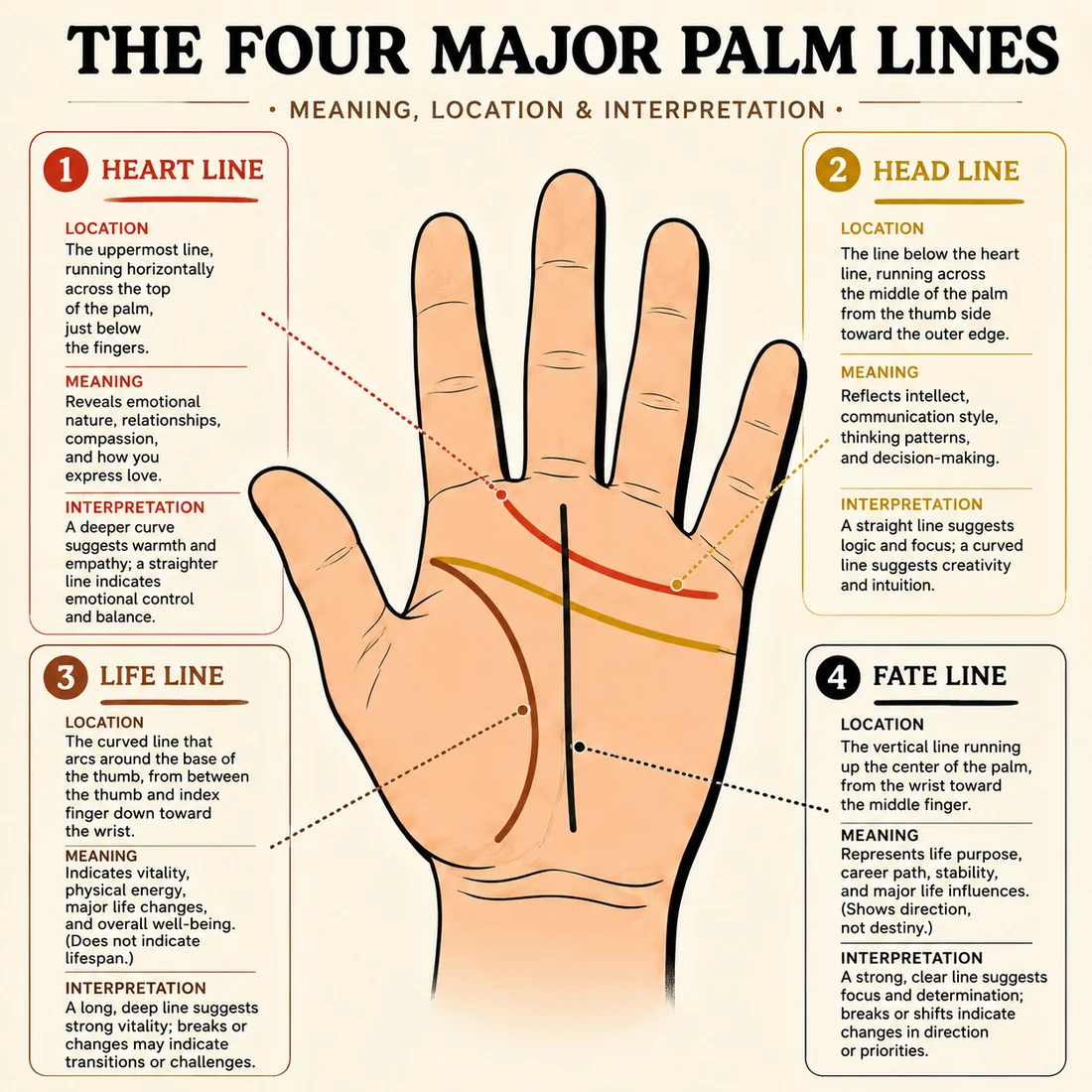
The three lines almost everyone has are the Heart, Head, and Life; the Fate line is the main vertical and the most variable. Read each line from where it starts to where it ends — a deep, clear line means steady energy in that area; a faint, chained, or broken line means scattered or fluctuating energy.
Heart Line
Governs: your emotional life, love, romantic style, and how you attach to others. the topmost horizontal line, running across the upper palm just below the fingers.
- Long, reaching under the index finger — Idealistic and romantic — gives the whole self, with high standards in love.
- Ending between index and middle finger — The balanced lover: warm yet realistic — traditionally the healthiest placement.
- Ending under the middle finger — Led more by the head (or the physical) than the heart; quick to commit, more self-focused in affection.
- Straight and parallel to the head line — Controls feeling with intellect — reserved, shows love through actions over words.
- Curving up toward the fingers — Expressive, warm, and openly affectionate — leads with feeling.
- Short (stops mid-palm) — Emotionally guarded; fewer but more intense attachments.
- Chained or broken — Fluctuating affections or a remembered heartbreak; an overlapping break is recovery.
- Forked at the end — Sees other viewpoints and balances them; a three-pronged fork is considered fortunate in love.
Head Line
Governs: your intellect, thinking style, learning, and mental discipline. the middle horizontal line, usually starting near the life line and crossing the palm.
- Long, reaching across the palm — A thorough, far-reaching thinker who weighs everything before deciding.
- Short (stops under the middle finger) — Focused and practical — prefers the concrete, decides quickly.
- Straight and horizontal — Logical, structured, realistic, business-minded.
- Curving down toward the Moon mount — Creative, imaginative, intuitive — the deeper the slope, the more artistic.
- Joined to the life line at the start — Cautious and considered; thinks before acting, sensitive to others' opinions.
- Separated from the life line (a gap) — Independent, bold, self-reliant; a wide gap signals an impulsive risk-taker.
- Forked at the end (writer's fork) — A versatile mind that holds logic and imagination at once — prized for writing and persuasion.
- Chained or wavy — Indecision, scattered focus, or mental strain.
Life Line
Governs: vitality, stamina, zest, and the journey of life — NOT its length. curves around the base of the thumb, arcing through the Mount of Venus toward the wrist.
- Long and deep — Robust traditional vitality, steady energy, and resilience.
- Short — Does NOT mean a short life — traditionally, energy conserved or steered by other forces.
- Wide arc (swinging into the palm) — Warm, enthusiastic, energetic — strong stamina and affection.
- Narrow arc (hugging the thumb) — Reserved and cautious, a quieter life with lower physical drive.
- Doubled (a 'sister line' inside it) — Extra vitality and a 'guardian' — strong support through hardship.
- Broken — A major change, disruption, or relocation; an overlapping break means life continues smoothly.
- Branches rising upward — Effort, ambition, and positive turning points.
- A square around a break — Protection — sheltered through a difficult time.
Fate Line
Governs: career, life direction, and how much life feels steered by fate versus self-made. the central vertical line, rising from the base of the palm toward the middle finger.
- Deep, straight, unbroken — A strong, settled sense of direction and a focused path.
- Absent or very faint — A self-directed, unconventional life — destiny isn't externally fixed (not a lack of success).
- Starting from the life line — Self-made success built through personal effort.
- Starting from the Moon mount — A path shaped by others, the public, or fortune — good for public-facing work.
- Starting high (mid-palm) — Finds true direction or settles into a career later in life.
- Broken — Changes of career or direction; an overlapping break is a smooth pivot to something better.
- Stopping at the head line — A mid-life career change made through a decision of the mind.
- Stopping at the heart line — Direction altered by a relationship or an emotional choice.
Minor & Secondary Lines
Not everyone has these — their presence adds the named quality; their absence is neutral, not negative.
Sun Line (Apollo / Line of Success)
A clear, deep Sun line signals a gift for shining and being recognized; multiple lines mean many talents that can scatter; absent is neutral — success simply comes through effort and the fate line.
Mercury Line (Hepatica / Business Line)
Traditionally, no Mercury line is the BEST sign — 'no news,' a steady constitution. A clear, straight one marks sharp business and communication instincts.
Affection / Marriage Lines
Short horizontal lines on the percussion edge below the little finger. Read as major attachments, never a literal marriage or divorce count. Curving up = a bond that lifts you; curving down = disappointment.
Girdle of Venus
A curved arc above the heart line. Refined and sensual when clear; restless or over-stimulated when broken.
Line of Intuition
A curved line on the Moon side. Strong instincts and vivid imagination; a 'sixth sense' in traditional terms.
Ring of Solomon
An arc at the base of the index finger. Marks a natural counselor, teacher, or mentor.
Travel Lines
Short lines on the percussion edge. A long, deep one is a life-shaping relocation; several mean a well-traveled life.
Simian Line
A single crease where the head and heart lines merge into one. Read symbolically for single-minded focus and emotional intensity only — it carries NO medical meaning and is a normal hand variation.
The Mounts & Their Planets
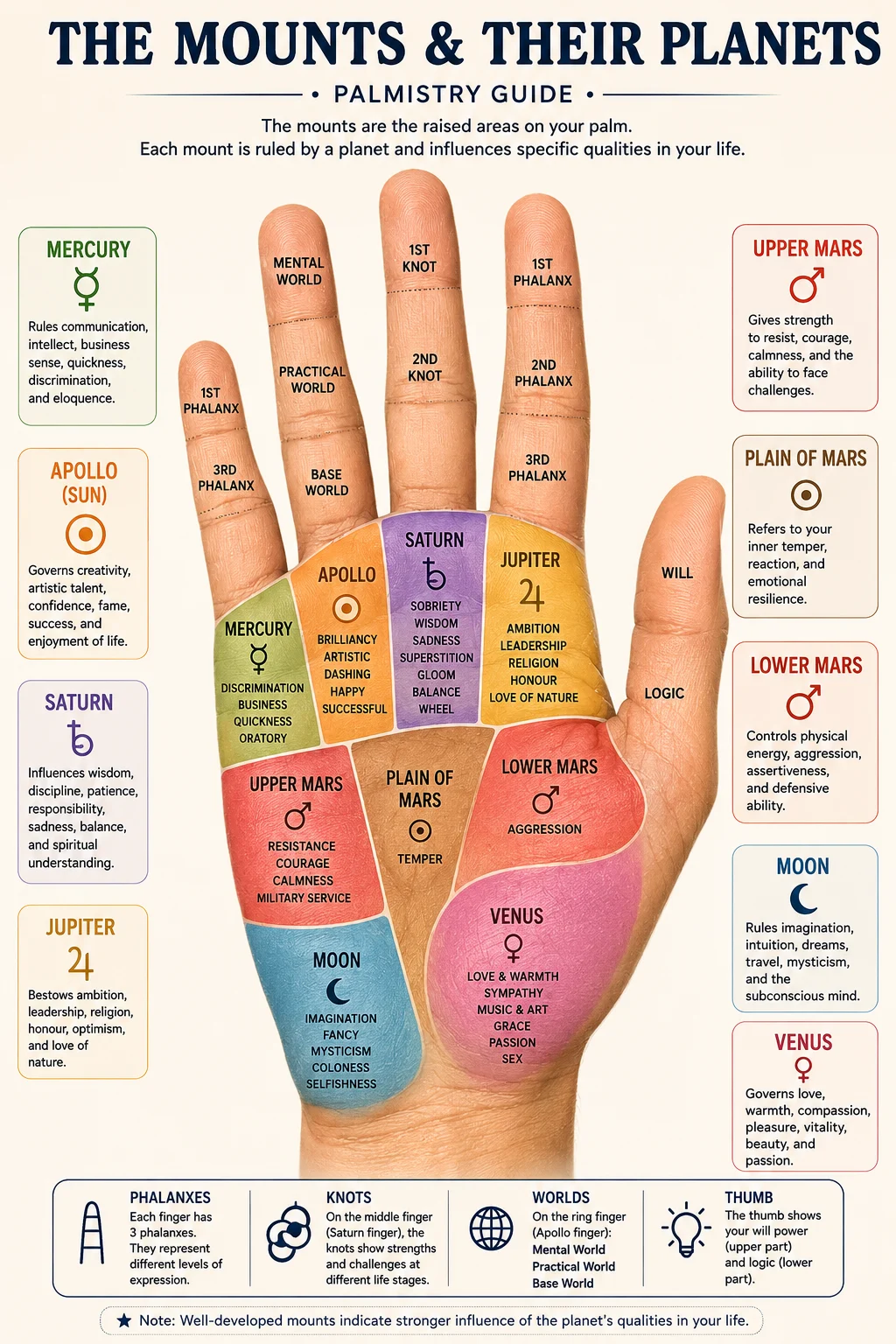
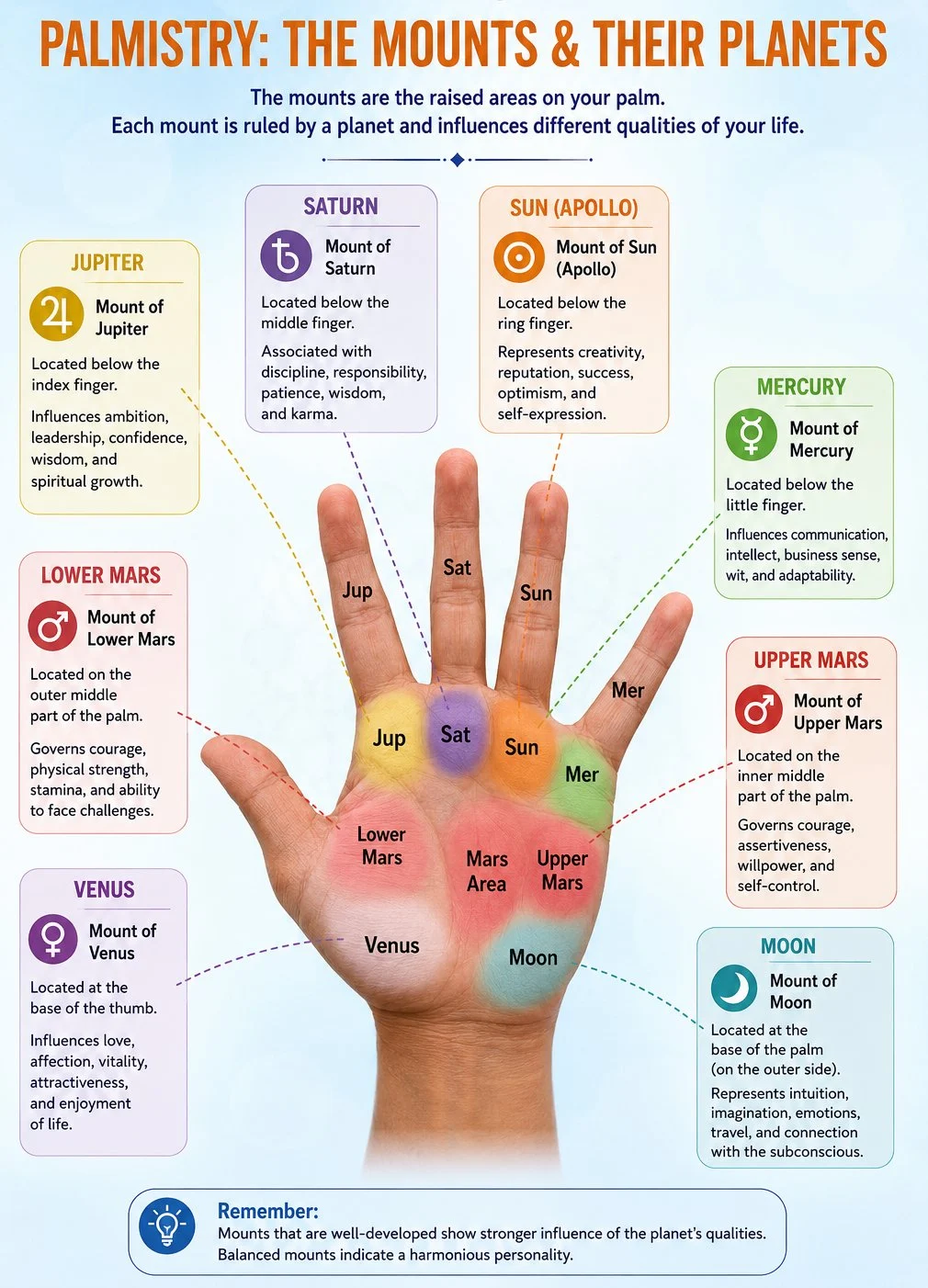
The mounts are the fleshy pads of the palm, each ruled by a planet. A prominent, firm mount means that planet's qualities are strong; a flat mount means they're dormant. Your most prominent mount is your “ruling planet,” coloring the whole hand.
The Four Hand Shapes (by Element)
The cleanest bridge from palmistry to astrology: your hand's overall shape maps to one of the four elements. Compare your palm (square vs. long) against your finger length(short vs. long). Your hand shape is your element made visible.
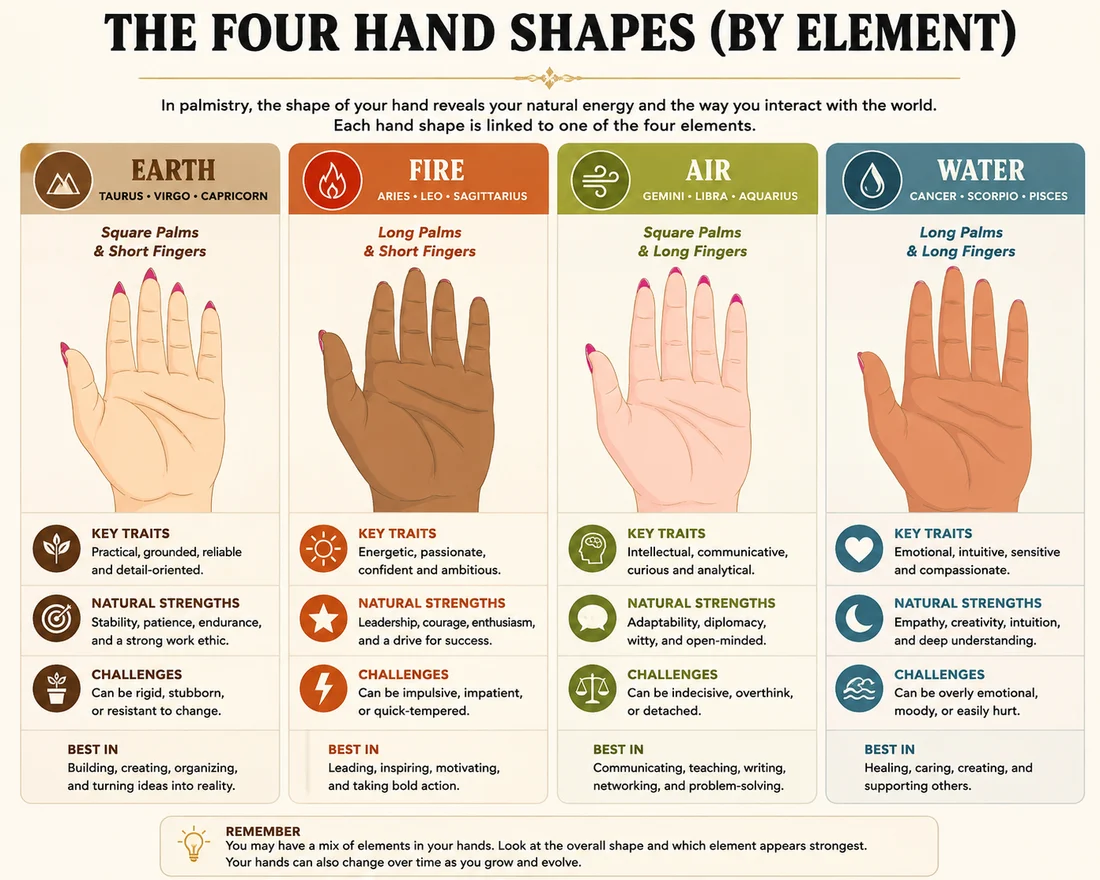
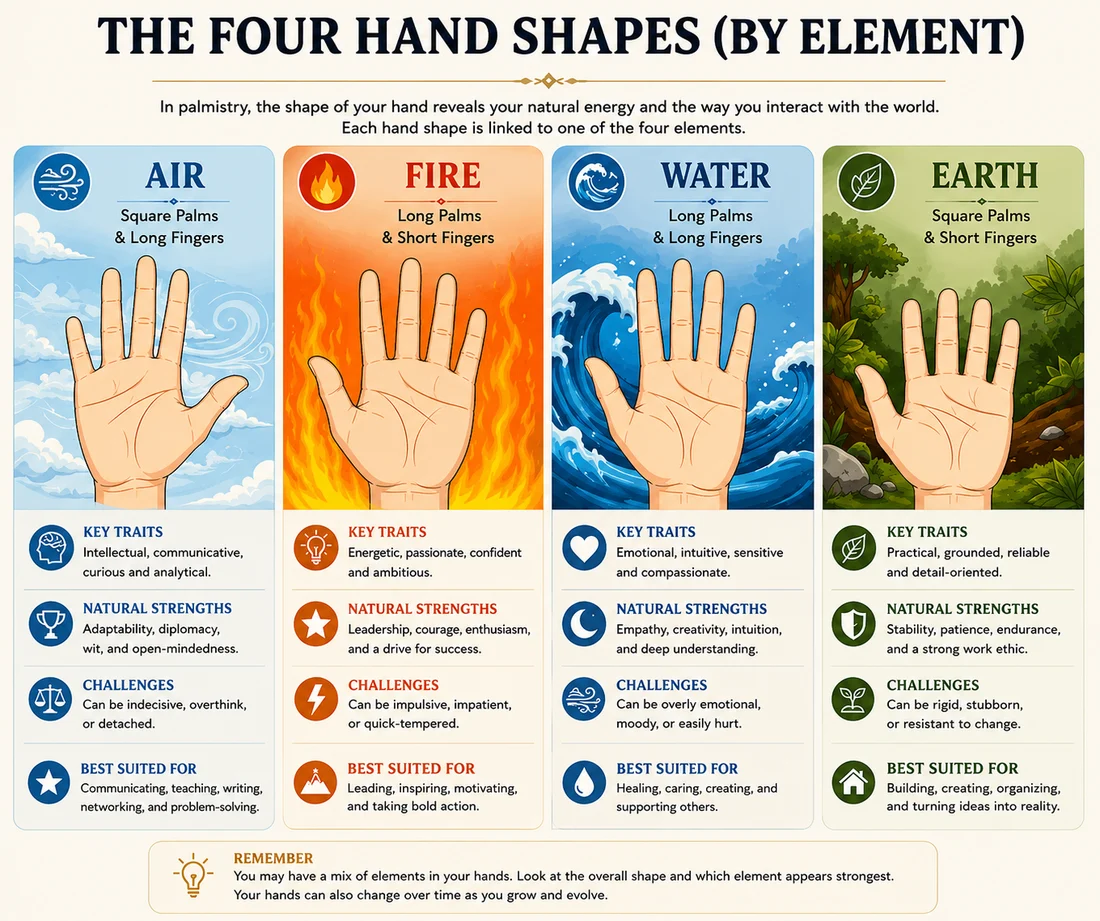
Practical, grounded, reliable, and patient. Values stability, routine, and the tangible; loyal but can be stubborn and resistant to change.
Reads as: The steady worker and builder — 'what you see is what you get,' with strong physical vitality.
Energetic, confident, spontaneous, and charismatic. A natural initiator who lives in the moment; can be impulsive, impatient, and quick to start but slow to finish.
Reads as: The doer and motivator — thrives on excitement, novelty, and being centre stage.
Intellectual, communicative, curious, and witty. Lives in ideas and words and needs mental stimulation; can be detached, anxious, or over-thinking.
Reads as: The thinker and connector — a problem-solver who craves conversation and mental freedom.
Fingers & the Thumb
Each finger carries its planet's symbolism — judge it by length, straightness, and set. The thumb is often called the single most telling feature: its upper section is willpower, its lower section logic, and how far it opens from the hand shows how open or guarded a person is.
Jupiter (index)
Saturn (middle)
Apollo (ring)
Mercury (little)
Special Markings
Small marks sit on a line or mount and modify it — the same mark means different things depending on where it falls, taking the flavor of the mount or line it touches.
Fingerprint Patterns
Fingerprints are fixed for life and read as the deepest layer of temperament.
Loop (most common)
Adaptable, easygoing, sociable, and flexible — a team player who goes with the flow.
Whorl (spiral)
Individualistic, independent, strong-willed, and original — needs autonomy and dislikes being told what to do.
Arch
Practical, grounded, reliable, and cautious — trusts the concrete and resists change; a 'show me' temperament.
Tented arch
Enthusiastic, idealistic, and passionate — a more excitable, cause-driven version of the arch.
How to Read a Palm, Step by Step
New to this? The beginner's palm reading tutorial walks a first reading in twenty minutes, in the order that makes the sections above readable: shape, then the four major lines, then the mounts, then the thumb.
- Note the hand shape and element first — it frames the whole reading and sets the temperament.
- Find the dominant mount — the firmest pad gives the “ruling planet” coloring.
- Read the four major lines in order — Heart, Head, Life, then Fate — for depth, length, and where they start and end.
- Add the minor lines that are actually present (never force-read ones that aren't there).
- Examine the fingers and thumb for length, set, and flexibility.
- Note fingerprints and any markings last, as fine-tuning.
- Compare both hands — the gap between potential and realized is the real story.
Which hand do you read?
Read them together. The passive (non-dominant) hand shows inherited traits and natural potential — your blueprint and your past. The dominant (active) hand shows what you've done with it — your present and developing future. Big differences between the two reveal how much someone has grown or changed. There's a deeper look in our guide to which palm to read, right or left.
Common beginner mistakes
- Reading the life line as a death clock — it governs vitality, never lifespan.
- Treating one feature as a verdict — always cross-check; the hand is a system.
- Reading only the dominant hand — you miss the potential-vs-realized story.
- Forcing meaning onto absent lines — no fate or sun line is neutral, even positive.
- Counting affection lines as literal marriages, or making any health claim from the hand.
The Astrology Bridge
Palmistry maps the seven classical planets onto the hand, which is what makes it a sibling of the horoscope. Each zone inherits its planet's temperament:
Curious where your hand's element points? Read your zodiac sign, find your Moon sign, or see your full birth chart.
Palmistry FAQ
Which hand should I read?
Read both. The dominant (active) hand shows what you've made of your potential — the present and developing future; the passive hand shows your inherited nature and starting point. The differences between them are the most telling part of a reading.
Does the life line show how long I'll live?
No. The life line is traditionally read for vitality, energy, and the journey of life — never lifespan. A short life line does not mean a short life.
Can a palm reading tell me about my health?
No. Palmistry is a symbolic, interest-and-belief tradition, not a medical or diagnostic tool. We never read the hand for health claims about a real person.
Do palm lines change over time?
The major lines are fairly stable, but fine lines and markings can shift over years as life and circumstances change — which is part of why palmists compare both hands.
Palmistry is presented here as a traditional, symbolic interest-and-belief framework — for reflection and entertainment, not medical, psychological, or factual prediction about any real person. See our editorial policy.