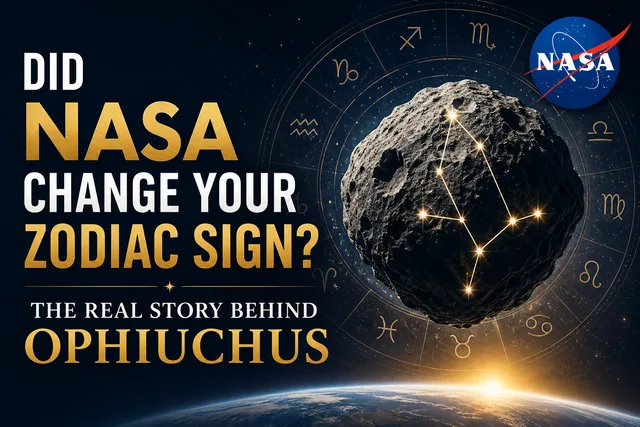
Quick answer
No, if you follow Western (tropical) astrology, your zodiac sign did not change. The viral "your sign is different now" story confuses two different zodiacs. Western astrology is anchored to the seasons, not the constellations, so its sign dates have stayed put for ~2,000 years. What is real is the astronomy behind the headline: the slow wobble of Earth's axis (precession) has shifted the constellations against the calendar, and the Sun really does pass through a 13th constellation, Ophiuchus. So the story is best read as a recurring media hoax built on top of real astronomy.
Hoax vs. reality at a glance
| Claim in the headlines | Verdict | Why |
|---|---|---|
| "NASA changed the zodiac" | ❌ Hoax | NASA studies astronomy, not astrology; it explained the sky, it didn't rewrite horoscopes. |
| "Your Western sun sign moved" | ❌ Hoax | The tropical zodiac is fixed to the equinox/seasons, so its dates don't drift. |
| "There's a 13th sign, Ophiuchus" | ✅ Real (astronomy) | The ecliptic crosses 13 constellations; the Sun is "in" Ophiuchus ~Nov 29, Dec 17. |
| "The constellations no longer match the dates" | ✅ Real | Precession has shifted them ~1 sign (~30°) since the dates were set. |
| "This is a brand-new discovery" | ❌ Hoax | Precession was described by Hipparchus ~2,100 years ago. Nothing new happened. |
What actually happened (the detailed explanation)
Every few years a wave of panic hits social media with the same headline: "Your zodiac sign has changed." The modern origin traces to January 2011, when Parke Kunkle, an astronomer on the board of the Minnesota Planetarium Society, gave a local newspaper interview pointing out a plain astronomical fact: the constellations no longer line up with the traditional astrological dates, and the Sun actually passes through a thirteenth one. Wire services stripped the nuance and turned a routine fact into "everyone's sign is wrong."
It flared again in 2016, when NASA published an educational page for children explaining that the ancient Babylonians had left a thirteenth constellation off the zodiac. As that spread, NASA issued a blunt clarification, in its own words: "Here at NASA, we study astronomy, not astrology. We didn't change any zodiac signs, we just did the math." (NASA, Zodiac)
The story spreads because it collapses two different systems into one:
- The tropical zodiac, used by Western astrology. Its starting point, 0° Aries, is defined as the March (vernal) equinox. The ecliptic is then divided into twelve equal 30° signs. Because the whole scheme is pinned to the seasons, precession doesn't move the dates, the Sun is still "in Aries" at the spring equinox, exactly as it was when the dates were codified. If you read Western horoscopes, your sun sign is unchanged.
- The sidereal zodiac, used by Vedic (Jyotish) astrology and aligned to the actual positions of the constellations. It corrects for precession with an offset called the ayanamsa, currently around 24°. In sidereal terms the sign-to-date mapping really is shifted by roughly a sign, but that's by design, not because anything "changed."
So nothing about astrology was rewritten in 2011 (or 2016, or since). What the headlines described is a real, long-known feature of the sky, applied to the wrong zodiac.
Did your sign change? It depends entirely on which system you mean
| System | What it's anchored to | Did your "sign" move? |
|---|---|---|
| Tropical (Western astrology) | the seasons / the March equinox | No. Dates are fixed to the equinox, unaffected by precession. |
| Sidereal (Vedic astrology) | the actual constellations | Shifted ~1 sign, but by design, corrected via the ayanamsa offset. |
| Astronomical (IAU constellations) | the real star boundaries | There are 13 ecliptic constellations of unequal size, never the same as the 12 even signs. |
The headlines pick whichever row is most alarming, drop the other two, and call it news.
Precession: the slow wobble that started it all
Earth doesn't spin perfectly upright. Like a slowing top, its rotational axis traces a wide circle, completing one loop in roughly 25,800 years (about 25,772, to be exact). This is the precession of the equinoxes, and it drags the equinox points westward against the background stars by about 1° every 72 years, a full zodiac sign (30°) every ~2,150 years.
The zodiac dates most people know were largely fixed by Babylonian astronomers and later formalized in the Hellenistic era (Ptolemy, ~2nd century CE). In the two millennia since, the constellations have slipped roughly one sign out of step with those calendar dates. That's why, astronomically, the Sun is in a different constellation than your "sign" on your birthday, even though your tropical sign hasn't moved. Precession itself is not new knowledge: Hipparchus documented it around 129 BCE.
A concrete way to picture how slow, and how real, this is: precession doesn't just shift the equinoxes, it slowly swings which star sits above the North Pole. Today that's Polaris. Around 3000 BCE, when the Egyptians were building the pyramids, the pole star was Thuban in Draco; in roughly 12,000 years it will be the bright star Vega. Same wobble, same ~25,800-year cycle, it just plays out far too slowly to notice in a lifetime, which is why a drift that's been underway for millennia can still be sold as "breaking news."
Ophiuchus and why there are 13 constellations but 12 signs
The path the Sun appears to trace across the sky over a year, the ecliptic, passes through thirteen constellations, not twelve. The extra one is Ophiuchus, the Serpent-Bearer; the Sun sits in front of it for roughly 18 days each year (about Nov 29, Dec 17), between Scorpius and Sagittarius.
This creates a problem for any neat calendar. When the International Astronomical Union (IAU) formalized the official constellation boundaries in 1930, it mapped the sky as it actually looks, irregular shapes, not a symmetrical grid, so the Sun's journey through them is wildly uneven. It spends a mere 7 days crossing tiny Scorpius (fewer than the ~18 it spends in Ophiuchus right next door), yet lingers for about 45 days inside the sprawling borders of Virgo. The twelve zodiac signs, by contrast, are tidy equal 30° slices of about a month each.
Astrology simply ignores that uneven map, and always has. The Babylonians were fully aware of Ophiuchus but deliberately left it off the wheel so that twelve signs would divide cleanly into a twelve-month calendar. Signs are a coordinate system; constellations are pictures in the sky of very different sizes, matching one to the other was an approximation from the start.
Why the story keeps coming back
If the astronomy is two thousand years old, why does "your sign changed" trend every few years? It makes a perfect viral package. The claim sounds like a personal revelation, your sign, specifically, is wrong. It comes with a ready-made villain whenever NASA is mentioned. And almost no one is ever taught the tropical-versus-sidereal distinction that quietly defuses the whole thing. Each cycle recycles the same true-but-misframed fact, lands on a fresh audience hearing it for the first time, and feels like news. It will happen again, and the astronomy still won't have changed, nor will your tropical sign.
Historical background
The zodiac is one of humanity's oldest organizing ideas. Babylonian astronomers divided the ecliptic into twelve equal parts in the first millennium BCE, tying them to constellations they already named. Greek astronomy inherited and systematized this, and crucially, Hipparchus discovered precession in the process, meaning the gap between "the signs" and "the stars" has been understood, by the people who built the system, from very nearly the beginning.
When Ptolemy compiled the astrological tradition in the Tetrabiblos, Western astrology had already drifted toward a season-anchored (tropical) framework, sign 0° Aries = the spring equinox. That choice is exactly why precession never "broke" Western astrology: it was anchored to a moving-with-the-seasons reference, not to the stars. Indian astronomy took the other branch, keeping the sidereal (star-anchored) zodiac and accounting for the drift explicitly.
Modern interpretation
So, hoax or reality? Both, depending on which half of the sentence you read.
- The sensational part, "a discovery means your sign secretly changed", is a hoax. No discovery occurred, NASA didn't touch astrology, and tropical sun signs are exactly where they were.
- The astronomical part, precession, the constellation drift, and Ophiuchus on the ecliptic, is completely real, and genuinely interesting.
The honest takeaway: Western astrology is a symbolic, season-based system, and on its own terms your sign is unchanged. The sky itself is a separate question, the constellations have drifted, and there's a thirteenth one on the ecliptic. Both things are true at once. The headlines just keep selling the gap between them as breaking news.
FAQs
Did NASA change the zodiac signs? No. NASA's own explanation emphasized that it studies astronomy rather than astrology, and that it was describing the positions of the constellations, not revising any astrological system. It described the sky (precession and Ophiuchus); it did not, and cannot, "rewrite" horoscopes.
Is Ophiuchus a real zodiac sign? Ophiuchus is a real constellation on the ecliptic, and the Sun does pass through it each year. But the zodiac used in astrology is a twelve-sign system, so most astrologers don't treat Ophiuchus as a sign. It's astronomy's 13th, not astrology's.
Why do astronomers say my sign is "wrong"? Because of precession: the constellations have shifted ~1 sign relative to the calendar dates over ~2,000 years. That's true for the astronomical constellations, but Western (tropical) astrology is anchored to the seasons, not the constellations, so its sign dates are unchanged.
What's the difference between the tropical and sidereal zodiac? The tropical zodiac (Western astrology) starts at the spring equinox and is fixed to the seasons. The sidereal zodiac (Vedic astrology) is fixed to the actual constellations and corrects for precession with an offset. The two differ by roughly 24° today.
So did my zodiac sign actually change? For Western astrology, no. For the sidereal/astronomical sky, the alignment has drifted, but that drift has been known for two millennia and isn't a recent event.
Related articles
- Ophiuchus personality traits, the "13th sign" in depth.
- Zodiac date ranges, the standard Western (tropical) dates.
- Zodiac signs & their symbols, the glyphs and what they mean.
- Is astrology a science?: how to think about astrology vs. astronomy.
About this article
Written by the AstrologyBay Editorial Team. The astronomy on this page is checkable: precession and its rate, the 1930 constellation boundaries, and the position of Ophiuchus on the ecliptic are all measured facts with sources below. Whether any of it changes your sign is a question about how Western astrology defines the zodiac, and that part is explanation of a convention rather than a claim about you.
Sources
- NASA on why the zodiac and the constellations no longer line up, and why NASA "did not change anyone's sign": NASA, Zodiac.
- Precession of the equinoxes, the roughly 25,800-year cycle at about one degree per 72 years: Encyclopaedia Britannica, Precession of the equinoxes.
- Hipparchus and the discovery of precession, second century BCE: Encyclopaedia Britannica, Hipparchus.
- The 88 modern constellations and the 1930 boundary work that put Ophiuchus on the ecliptic: Encyclopaedia Britannica, Constellation.
- The January 2011 media episode began with an interview given by Parke Kunkle of the Minnesota Planetarium Society; contemporaneous coverage is widely archived but not linked here, because no single report is authoritative for the astronomy above.